
New PhDONE – Congrats Michela!
On January 15, 2026 Michela Colombo successfully defended her PhD thesis entitled “Uncertainty in Probabilistic Fault Displacement Hazard Analysis: a sensitivity study and application to the Rieti Basin (Central Italy)”.
Michela’s project was realized in the framework of the Geosciences-IR project, coordinated by Ispra and devoted to the development of a cloud research infrastructure, useful for the regional Geological surveys of Italy.
Michela’s thesis explores three main aspects:
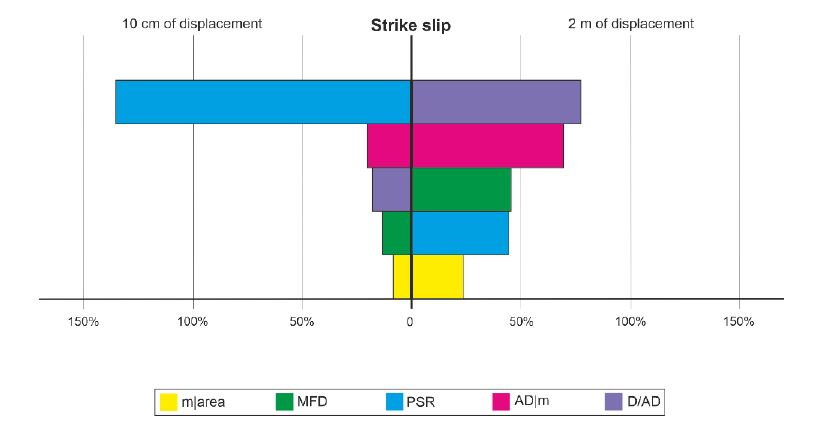
- Sensitivity analysis to evaluate the influence of the several parameters that are used as input data for fault displacement hazard assessment in a probabilistic framework (PFDHA). This was carried out by applying a “one factor at a time” method.
- Application of the PFDHA approach to a case study, building upon the work recently published by our group (Livio et al., 2026) that involved extensive paleoseismic trenching in the Rieti basin.
- Update of the SURE (Surface Rupture due to Earthquakes) database, which represent a standardized compilation of rupture maps and fault displacement measurements.
The results have both a theoretical and applied valency, pointing to the need to carefully evaluate the source of uncertainty in PFDHA studies. Indeed, each input parameter has a peculiar impact on the obtained hazard curve (Figure 1).
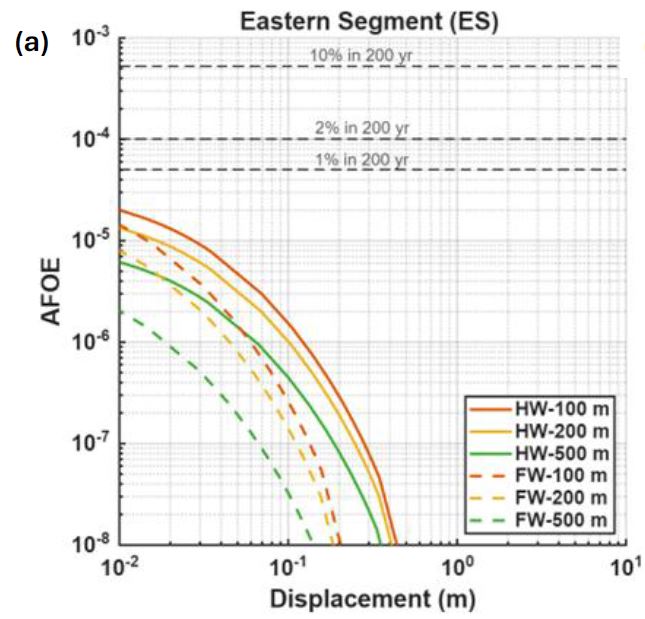
The application of the methodology to the Rieti basin provides a preliminary estimate of fault displacement hazard (Figure 2) and paves the road for more detailed studies in the same area and in other similar regions.
Congratulations Michela!